Explore the Modeling Functions
The system module provides an intuitive environment for quickly and efficiently developing gearbox and drive train concepts. With the integrated Sketcher, engineers define the system component topology as if using pen and paper. A comprehensive element library, named ‘element box’, covers all common gear and bearing types.
This visual and parametric modeling allows for an easy definition of complex kinematics, including special planetary stages, power splits and CVT paths. Modeling assistants accelerate model creation, while the automatic 3D viewer performs concept checks for spatial arrangements and collisions simultaneously. This significantly accelerates the concept phase, reduces potential design errors, and ensures that project progress is always visible to stakeholders.
Intuitive Modeling of Gearboxes and Drive Trains
Below you will find an overview of the modeling functions within the KISSsoft System Module, highlighting its key functions and capabilities.
Sketcher
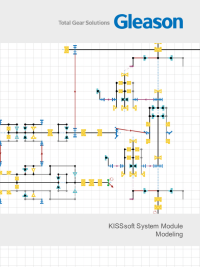
The Sketcher is a core function within the module, offering an intuitive tool for the topological definition of complex gearboxes and drive trains. It enables rapid concept development and variant comparisons by allowing visual modeling on a grid, like sketching the system with pen on paper. Shafts constitute the foundation of the model. Machine elements such as gears, bearings or connections are placed on the shafts with a mouse click and are connected using drag and drop to define meshes and couplings. This symbolic presentation provides an abstract overview of the complete transmission system. Any change made in the Sketcher is immediately and automatically visualized in the 3D viewer, enabling rapid check of the spatial arrangement and design space utilization. The topological definition can be created either in the Sketcher or in the tree structure, with both views interacting seamlessly.
Modeling Assistant
The modeling assistant is designed to accelerate model building and to ensure consistency, especially for standardized gear stages. This tool primarily intended for system architects who need to quickly compare various configurations in the early stage of the design phase. The assistant offers predefined, tested assemblies for group modeling that can be inserted directly into the system model.This feature also includes initial sizing for gears, proposing rough but realistic dimensions based on power requirements. The predefined groups cover a wide range of typical applications and ensure that the kinematic relationships are correctly established.
Variants
The calculation of variants is a specialized management tool that allows system architects to control the complexity of gearbox series or the development of variants within a single system file. It provides centralized definition and management of multiple variants, which is crucial when different gear ratios or configurations are required within a product line sharing the same kinematics. All relevant information is stored centrally in a single table, eliminating the need to create a new system file for each variant. This approach simplifies the documentation process and facilitates comparison of results between variants, for example, to determine which configuration yields the highest safety factors or efficiency.
Kinematics
Kinematics calculation is the core tool of this module, enabling precise analysis of speed, torque and power in highly complex gearboxes and drive trains. This function is essential for system architects in concept development, power flow evaluation, and loss distribution. The calculation extends beyond simple cylindrical gear train models and supports detailed consideration of power splits and transmissions with switchables. Special emphasis is placed on modeling advanced planetary systems and variable ratio transmissions. The integrated switching matrix serves as a powerful instrument for defining operating conditions by setting the status of all switchables for each gear shift.
Elements
The element library provides component experts with a comprehensive selection of predefined elements, classified according to international standards, to quickly assemble complete gearboxes and drive trains. This library ensures full compatibility of all components with KISSsoft submodule calculations. Elements can be managed and positioned both in the Sketcher and in a tree structure. With its modular structure, the library supports fast integration of complex subassemblies, such as coaxial shaft systems or shaft-hub connections, significantly reducing the modeling time.
System Data
The ‘system data’ tab provides centralized management of operating parameters that affect the entire gearbox model or multiple component submodules. This feature is essential for system architects and component experts, as it ensures consistency of non-geometric input data across the entire drive train and eliminates errors caused by inconsistent manual entries. Parameter values, such as oil temperature, lubricant grade or specific derating factors are defined once at system level and automatically propagated to all relevant submodules, avoiding manual parameter input and maintenance for each individual component module.